
Organization
The beginnings of IMACS date from 1955, when an International Conference on Analog Computation was held at the Brussels Free University (ULB), attended by scientists and managers of simulation laboratories from different parts of the world. Many of these laboratories were by products of the enormous technological developments that had been brought about by World War II. The participation was truly international, with attendees coming from most European countries including Russia, the United States of America, Japan.
During the conference, it was realized that there was a need for establishing some permanent means of communication between the members of this new scientific community. What resulted was the creation of AICA (the International Association forAnalogue Computation) which was legally incorporated under the Belgian Law in 1956.
The birth of AICA illustrated the emergence, at thetime, of disciplines spurred by new technologies, in particular thoseresulting in tools having to do with the mechanization of informationand computation. The example was followed in short order by theformation of other organizations in particular fields of applications, namely IFAC (Automatic Control, 1957) , IFORS (Operations Research-1959), IMEKO (Measurement – 1959) and IFIP (Information Processing-1960).
In 1972, these five organizations decided to coordinate their activities with the creation of FIACC (the FiveInternational Associations Coordinating Committee), which was created with the support of UNESCO.
It had been under Jean Hoffmann, Professor at theBrussels Free University (ULB) that the 1955 International Conferenceon Analog Computation that gave birth to AICA was organized. He became President of the newborn association, a post he held until 1973.
The objectives of AICA remained pretty much unchanged during that period, objectives related to analog computation developed as a tool for applications to mostly industrial problems.This included hardware questions, mathematical and programming aspects with some consideration, beginning in the mid-1960’s, to what had emerged as hybrid computing, i.e. computing involving linked analog anddigital machines.
Hoffmann was succeeded by Professor Robert Vichnevetsky who was elected President at the Association’s 7th World Congress in Prague, August 1973. It was during Vichnevetsky’s tenure that the Association grew, leading to the visibility it holds today inscientific computing and applied mathematics. Significant developments were taking place in the sciences at the time and the scope of what was still known as AICA began to expand to include numerical computing, subdisciplines in applied mathematics, and the introduction of mathematical modeling in many of the traditional fields of the applied sciences that had to change their ways to keep up with the new environment. In 1976, AICA changed its name to IMACS (International Association for Mathematics and Computers in Simulation) to reflect the widening of its areas of interests.
IMACS also expanded its administrative structure, its international coverage with legal incorporations and offices in both the USA and Belgium and affiliated societies in other parts of theworld – as far as China, Japan and Australia/New Zealand (which, in a way, illustrates the fact that the globalization of science preceded the globalization of industry – something that remains true in following years)
Disciplinary directions
The post World War II yearshad been characterized by significant changes in the of sciences and industry brought about by what has come to be called the computer revolution, the mechanization of computation and information processing. There had been modest beginnings in earlier times (to which the names of Pascal, Leibniz, Jacquard, Babbage, Kelvin, Hollerith and others are attached in historical reconstructions), but it was not until the middle of the 20th century that computers and the many ramifications related to the theoretical tools needed for their applications became a field of its own, with research, funding and industrial development to back it up. Significant communities of scientists, engineers, technicians engaged in these developments appeared in developed countries throughout the world.
One of the earliest class of scientific problems solved by machines was that of computing the dynamics of mechanical and similar systems, those described with differential equations. Analog computers achieving this had been built since the 1930’s (Vannevar Bush at the MIT). ENIAC, the first significant digital computer– built at the University of Pennsylvania during the war years (Eckert, Mauchly, with a significant participation by von Neumann) was likewise intended for the solution of the differential equations, those describing the trajectory of projectiles above the Earth. And itis by no coincidence that it is the same class of problems that had led to the development of Calculus in the 17th century (Galileo, Huygens, Newton, Leibniz).
Two resulting communities — the analog and the digital — remained pretty much separated for a number of years, with some of the protagonists talking of a “war” between the two (which it was not). The digital side did gradually take over with the increasing power and decreasing cost of its hardware. Little analog computation was left by the middle 1970’s.
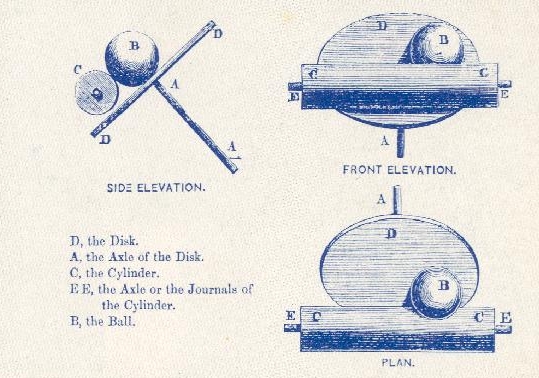
In the 1930’s, James Thomson’s ball and disk integrator (1876) was one of the first analog computing devices. It was used by Lord Kelvin, James Thomson’s brother, to describe the possibility of solving differential equations with machines. But It was not until several decades later (Vannevar Bush and colleagues at the MIT) that machines used to carry out actual calculations were to see the light.
An analog computer of the late 1950’s. Those machines were more powerful than digital computers for applications requiring modest accuracy, and IMACS (then still AICA) played an important role in the introduction of this computing tool in the industrial world, playing an important role in the beginnings of computer simulation in industrial and scientific development. E.g. they were essential to the US Space program of the 1960s, and held an important place in the study of the safety of the many nuclear power plants built in Europe in the post WW II years.

What is today at the center of IMACS’s disciplinary interests may be described in broad terms as the development of theoretical concepts and algorithmic tools that use computers (digital computers : analog computers have become practically obsolete) and mathematics, in the abstract as well as in the context of specific applications. They are “tools” in the sense that they will -at least in theory- be used by others, members of some “end use discipline” such as engineering and physics.
Those directions have changed and will by definition continue to change with time. New groups with particular interests appear, old ones become dormant (although some have shown remarkably stubborn resilience to do so irrespectively of what was happening in the outside world. We have in our midst nice examples and counter examples of the dynamics of what Thomas Kuhn called “Scientific Revolutions”).
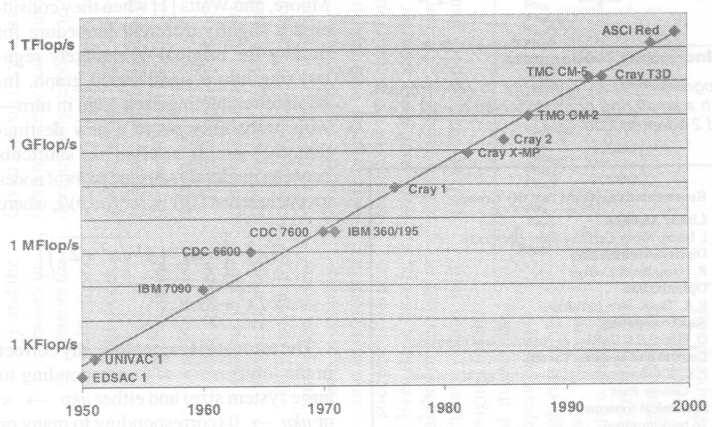
The rise in power of electronic computers in the second half of the 20th century has been followed by a corresponding increase in the number of areas of research made possible by new tools in applied mathematics allowed by this new hardware. It is the development of those tools and related questions of mathematical modeling that have been – and still are – at the core of IMACS’s role in the applied sciences.